


“Our challenge as theater makers,” Willem Dafoe says in the official 2026 World Theatre Day message in the video below, “is to avoid the corruption of theater solely as a commercial enterprise dedicated to entertainment by distraction or as the institutional dry preserver of traditions, but rather to foster its strength, to connect peoples, communities, cultures, and above all, to question where we are going.”
World Theatre Day has been celebrated internationally every March 27th since 1962, Each year, a world-class theater artist has been chosen to deliver a message. The first was Jean Cocteau. This year, it is Willem Dafoe, better known as a movie actor but with deep roots in experimental theater, having co-founded the avant-garde Wooster Group in New York in 1980.
In recent years, there has also been a separate message by a theater artist from the United States. This year, there are two, from director Moises Kaufman and playwright Banna Desta. They too are below.
In keeping with my tradition on World Theater Day, below are photographs of 10 beautiful theaters from around the world, 10 great books about New York theater, and 10 facts (at least one of them dubious) about theater.
Click on each photograph to see it enlarged
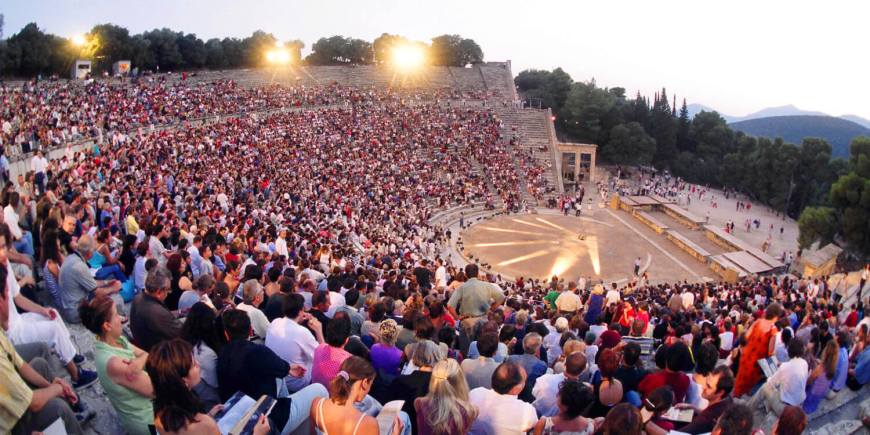


Theater isn’t just the buildings in which it takes place. The word “theater” comes from a Greek verb meaning ‘to behold’.
Behold these books about New York theater (listed chronologically by publication date, and linked to their page on Amazon)


Act One: An Autobiography by Moss Hart (new edition St. Martin’s, 464 pages)
Moss Hart’s eloquent, entertaining (and, many say, much fictionalized) chronicle of his impoverished childhood and his long, determined struggle to reach the opening night of his first Broadway hit, originally published in 1959.
Not Since Carrie: Forty Years of Broadway Musical Flops by Ken Mandelbaum (St. Martin’s Press, 1992, 384 pages.)
An entertaining and informative capsule descriptions of hundreds of Broadway failures from 1950 to 1990.
Hat Box: The Collected Lyrics of Stephen Sondheim (Knopf, 2011, two volumes)
The master lyricist and composer’s annotated lyrics, along with brief history of how each of his shows came to be, and many useful, informed, opinionated digressions about the theater.
Song of Spider-Man: The Inside Story of the Most Controversial Musical in Broadway History by Glen Burger. (Simon and Schuster, 2013, 384 pages.) An instructive history of the Broadway musical “Spider-Man: Turn Off the Dark” which broke innumerable records both good and bad (the highest attendance in a single week, the longest preview period, the biggest money loser, etc.), by a writer who with Julie Taymor and Roberto Aguirre-Sacasa is credited as the author of the musical. “Before something can be brilliant, it first has to be competent” is at the top of his list of lessons learned.
Tennessee Williams Mad Pilgrimage of the Flesh by John Lahr (W.W. Norton & Company, 2014, 764 pages.) Some 40 books have been written about playwright Tennessee Williams since his death in 1983. I haven’t read enough of them to offer an authoritative judgement, but it’s hard to imagine one better-written or more informative than this one, written by the former chief theater critic of the New Yorker.
Razzle Dazzle: The Battle for Broadway (Simon and Schuster, 2015, 464 pages) is the first book by
Michael Riedel, theater columnist for the New York Post from 1998 to 2018 whom theater people loved to hate. But Riedel leaves his withering remarks to himself in this history of Broadway in the 1970s and 1980s. Focusing on the Shubert organization, he recounts how the Broadway industry, on the verge of collapse, was reborn, both helping (and helped by) the transformation of Times Square and the city as a whole. But to tell the story, the book ranges nearly the breadth of the 20th century.
The Secret Life of the American Musical: How Broadway Shows Are Built by Jack Viertel. (Farrar, Straus and Girous, 2016, 312 pages.) The wonderfully readable book focuses on the structure of successful musicals, going chronologically step by step from the overture to the finale. But underneath the rulebook, he is arguing persuasively for the importance of the American musical: “If Shakespeare is England’s national theatre, aren’t Broadway musicals ours?”
Shakespeare in a Divided America: What His Plays Tell Us About Our Past and Future James Shapiro (Penguin, 2020, 286 pages) The Shakespearean scholar who is the author of The Year of Lear: Shakespeare in 1606 and 1599:A Year in the Life of William Shakespeare looks at eight controversial events involving Shakespeare, which he calls “defining moments in American history.” Each chapter focuses on a specific year, a specific play by Shakespeare, and specific issues of the day, which largely remain American issues today — long-standing tensions involving race, class, gender, immigration and other fault-lines in American culture.
“Putting It Together: How Stephen Sondheim and I Created ‘Sunday in the Park with George’” (Farrar, Straus and Giroux, 2021, 416 pages) is an eccentric, valuable and entertaining book, which author James Lapine describes early on as “a mixed salad: one part memoir, one part oral history, one part how a musical gets written and produced.’” It also includes the full script of Lapine and Sondheim’s 1984 Broadway musical,
Shy: The Alarmingly Outspoken Memoirs of Mary Rodgers (Farrar, Straus and Giroux, 2022, 480 pages) written with the then-New York Times chief theater critic Jesse Green, based on several years’ worth of twice-weekly interviews, and published eight years after the death at the age of 83 of this composer, screenwriter, and author who was Broadway royalty from birth, as the daughter of Richard Rodgers.
–
10 facts about theater
The earliest archaeological evidence of theatrical spaces dates to 2000 B.C.E. in Crete, an island in the Mediterranean Sea south of Mainland Greece.
Theater originated in Ancient Greece around 600 B.C.E. as religious festivals for Dionysus, featuring chorus members in goat skins .(The word “tragedy” derives from the Greek words for “goat song”
The first person to step out from the goat-skinned chorus and play individual characters was named Thespis, which is the origin of the word thespian, now used primarily for actors in high school.
I’m not sure I believe this, but numerous sources say that audiences in Ancient Greece initially stamped their feet rather than clapped their hands to show approval.
The oldest play that has survived intact is The Persians by Aeschylus, written in 472 BCE.
The largest building used for theatrical performances is The Great Auditorium in The Great Hall of the People, Beijing, China, which seats approximately 10,000 people. (Guinness Book of World Records)
The smallest professional theater is the Kremlhoftheater in Villach, Austria, which has a maximum capacity of 8 seats. (Guinness Book of World Records)
The longest Broadway run of a play by William Shakespeare was “Othello” starring Paul Robeson, which opened in October 1943 and ran for 296 performances.
The world’s longest-running play is Agatha Christie’s “The Mousetrap” which opened on the West End in 1952
New York City has the highest concentration of theatres in the world, with over 400, followed by Paris, Tokyo, and London.
A good source of information are the 50 videos from PBS Studio’s Crash Course in Theater and Drama.
