
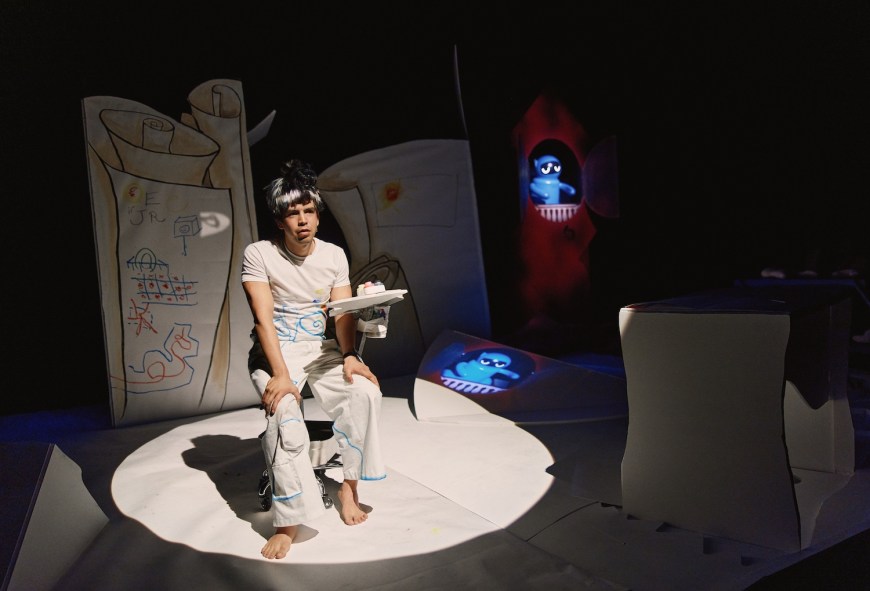
“Color Theories” is funny and weird and sometimes confusing. It reminded me at various times of Pee Wee Herman (childlike tone, cartoonish set, puppetry), George Carlin (observational and political humor), and Andy Kaufman (is he kidding or for real?), although none of those comparisons are really accurate, since the show is uniquely Julio Torres. His gently surreal take on the world will be familiar to those who have seen his 2019 special “My Favorite Shapes,” 2023 movie “Problemista” or 2024 TV series “Fantasmas” (all on HBOMax.) Now, in his Off-Broadway debut, he climbs out of a hole in the stage and tells us almost immediately that, contrary to rumors, this new show of his is not an Off-Broadway play.
What “Color Theories” is, he says, is a lecture, one that will soon be a mandatory course in all New York City public schools. “Now you must be wondering: ‘How could he possibly make this happen?’ Well, I have donated $130 to Zohran Mamdani’s mayoral campaign, making me one of his largest contributors. The man is my puppet.”.

On a set that resembles a giant pop-up book, Julio sits on a mobile chair in front of an easel, wearing what looks like a double-decker wig or a dead bird but could be a light or a camera on his head (it’s confusing.) Two mute stagehands (aides? extras?) help him move things around and flap open the various secret compartments on the set; both are dressed as inanimate objects – one is a music box, the other turns out to be spilled wine (initially confusing.)
He tells us he’s going to go color by color but will run out of time before he gets to all of the colors. Initially, there is no evident logic to his theories about color; he tells us “the sound of rain is green. A child flying a kite is yellow.” Barbra Streisand cloning her dog, he says, is purple.
But eventually, they do start to make a loopy kind of sense. The primary colors, red, blue and yellow, embody passion, logic and joy respectively. If you combine yellow and blue you get green. “Green is when something is orderly but joyful, like a family of ducks swimming”
He spends a great deal of time with navy blue, a color he clearly disfavors, although at one point he makes an effort to describe it objectively. “Navy blue is when you combine pure blue (logic) with black. What is black? Black is the unknown. White is what we know. It’s not good and evil, we don’t do that here. It’s knowing and not knowing. That’s why waiting rooms are grey, why anxiety is grey—because they are the limbo between knowing nothing and knowing something.”

Thankfully, he digresses frequently from his disquisition on color. He spends time talking about piñatas, asking us to close our eyes and imagine one, and wondering why it is that parents give their child a pinata of their favorite cartoon character so that they can beat it to death. He opens up a giant picture book and flips through page by page that illustrates his (G-rated) riff on animal sex (“The nature documentarian was fascinated by the notion that dolphins were one of the few animals to have sex for pleasure, which made him wonder if there are any animals to have sex to get ahead.”)

He offers at one point a hilarious anecdote of unsuccessfully transferring his data to his new phone, and the resulting exasperating encounter with an Apple “genius.” Another long anecdote, about an older actor who refused to acknowledge his toupee to the hair stylist, is just odd.
Throughout the show, Bibo, a (blue?) robot, pops out of a grandfather clock to remind Julio to keep the show moving (“Hurry you have to move on, do yellow!”) By the end, there is tension between them. Bibo confronts Julio on his bias against navy blue, and his need to classify things. Bibo tells the chastised Julio that he’s written an ending for him, and hands it to him. Julio starts reading: “He began to question the rigidity of his theories.” He re-evaluates some of his theorizing; maybe Barbra Streisand’s dog-cloning is “green in its pursuit for life or yellow because she just likes to play with her dog.”
Julio apparently sees the light: “To learn how to see, we must first learn we can never see it all,” he says (or is he still just reading what Bibo wrote for him?) He chatters on about clear notebooks and building pools in schools…”Zohran needs to fund deep sea expeditions for every student…” it’s not the best ending. I suspect he felt the need to have that confrontation with Bibo and then an epiphany, so that “Color Theories” would more clearly resemble an Off-Broadway play. Or maybe that’s really what happened. With Julio Torres, very little is black and white.
Color Theories
Performance Space New York through October 5
Running time: 80 minutes
Tickets: $109 – $209
Written and performed by Julio Torres
Scenic design by Tommaso Ortino, costume design by Muriel Parra, lighting design by Emmanuel Delgado, sound design by Christopher Darbassie, composed by Lia Ouyang Rusli, video and projection design by André Azevedo Sweet, director of photography Sam Levy, puppets and puppetry by Monkey Boys Productions, artistic consultant Jack Serio
Bibo: Joe Rumrill
Spilled Wine: Drew Rollins
Music Box: Nick Meyers
Puppeteer: Ian Edlund
Photographs by Emilio Madrid
